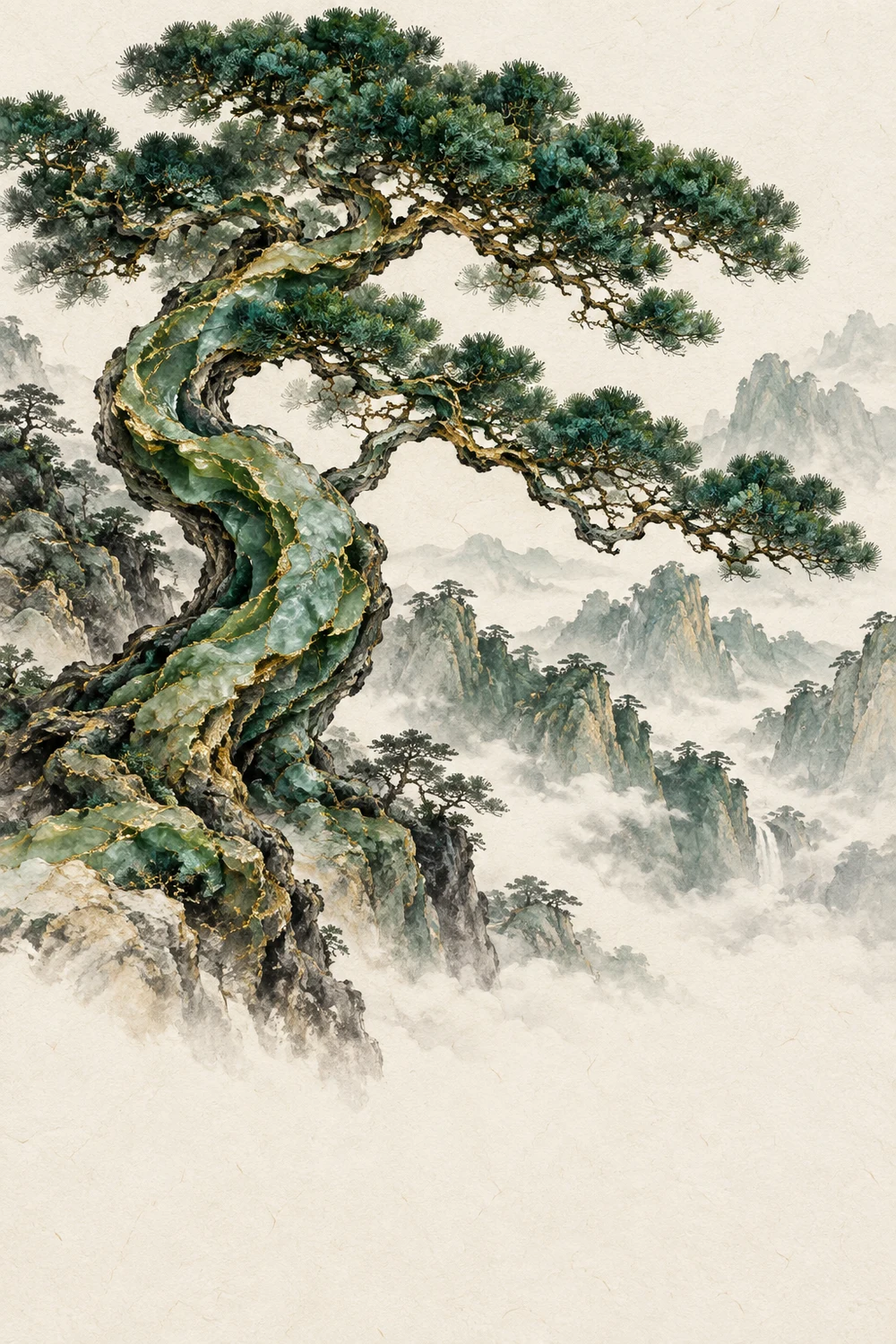
The Vine on the Trellis
A tall pine grows by pushing straight toward the canopy; ivy reaches the same light by feeling along rough brick and turning corners. In Chinese BaZi—a birth chart built from four pillars of two characters each—the Wood phase splits into those two images. While Yang Wood (甲 Jiǎ) resembles the upright trunk, Yin Wood (乙 Yǐ) is the vine, grass or supple shoot that advances through contact and adjustment.
乙 Yǐ is one of the ten Heavenly Stems. When it sits at the top of your day pillar, it serves as your Day Master, the central reference point of the chart. If 乙 Yǐ appears in your year, month or hour pillar instead, it contributes to your overall eight-character picture without making you a Yin Wood Day Master. We give the 乙 Yǐ Day Master the modern editorial title The Quiet Alchemist to highlight its knack for combining what is already in the room, not to replace the classical stem.
Tact, Ingenuity and the Cost of Blending In
As a reflective lens, Yin Wood invites you to notice how you work with constraints. Imagine a fictional project team deadlocked between two loud, competing proposals. Rather than forcing a third vote, someone with a Yin Wood approach might salvage the sharpest mechanism from the first plan, pair it with the timeline of the second, and hand both rivals a compromise they can claim as their own.
Yet a metaphor built on flexibility carries an obvious counterweight. If you always bend around the nearest obstacle, do people actually know where you stand? You might test this image against your own week and disagree with it entirely—perhaps you prefer blunt confrontation over careful diplomacy, or perhaps you only play mediator when a paycheck is on the line. A single stem is an angle of observation, never a verdict on your character.
One Unpadded Request: A Contemporary Exercise
To try on the Yin Wood question in real life, watch how you phrase a small boundary over the next two days. Pick one minor friction—declining an optional meeting, asking a roommate to clear the sink, or revising a deadline—and state your preference in a single sentence without cushioning it in three paragraphs of apology.
Afterward, jot down two quick notes: one moment where tactful adjustment solved a problem, and one where directness worked better than hinting. Seeing both side by side keeps the archetype grounded in what the situation actually required.
Where 乙 Yǐ Fits in the Full Chart
If you generate a free chart on Your Destiny Atlas, remember that having an 乙 Yǐ Day Master is distinct from having a high percentage of Wood. Our five-phase bars simply tally the eight visible characters at 12.5% each, without hidden stems, seasonal weighting or favorable-element prescriptions. A Yin Wood Day Master can easily sit inside a chart dominated by Metal or Fire.
Because our calculator uses local civil time with a midnight day rollover and solar-term boundaries (such as Li Chun for the year), charts cast near midnight or a seasonal transition may differ on sites that apply true solar time. If you want to see how 乙 Yǐ contrasts with its louder counterpart, read the entry on 甲 Jiǎ Yang Wood next.
Find the story in your own chart.
Calculate your four pillars, meet your Day Master and take away a signature card.
Reveal my signatureCalendar reference: Hong Kong Observatory: the 24 solar terms. Calculation engine: lunar calendar documentation. Archetype labels, exercises and artwork are modern editorial interpretations. Read our method.