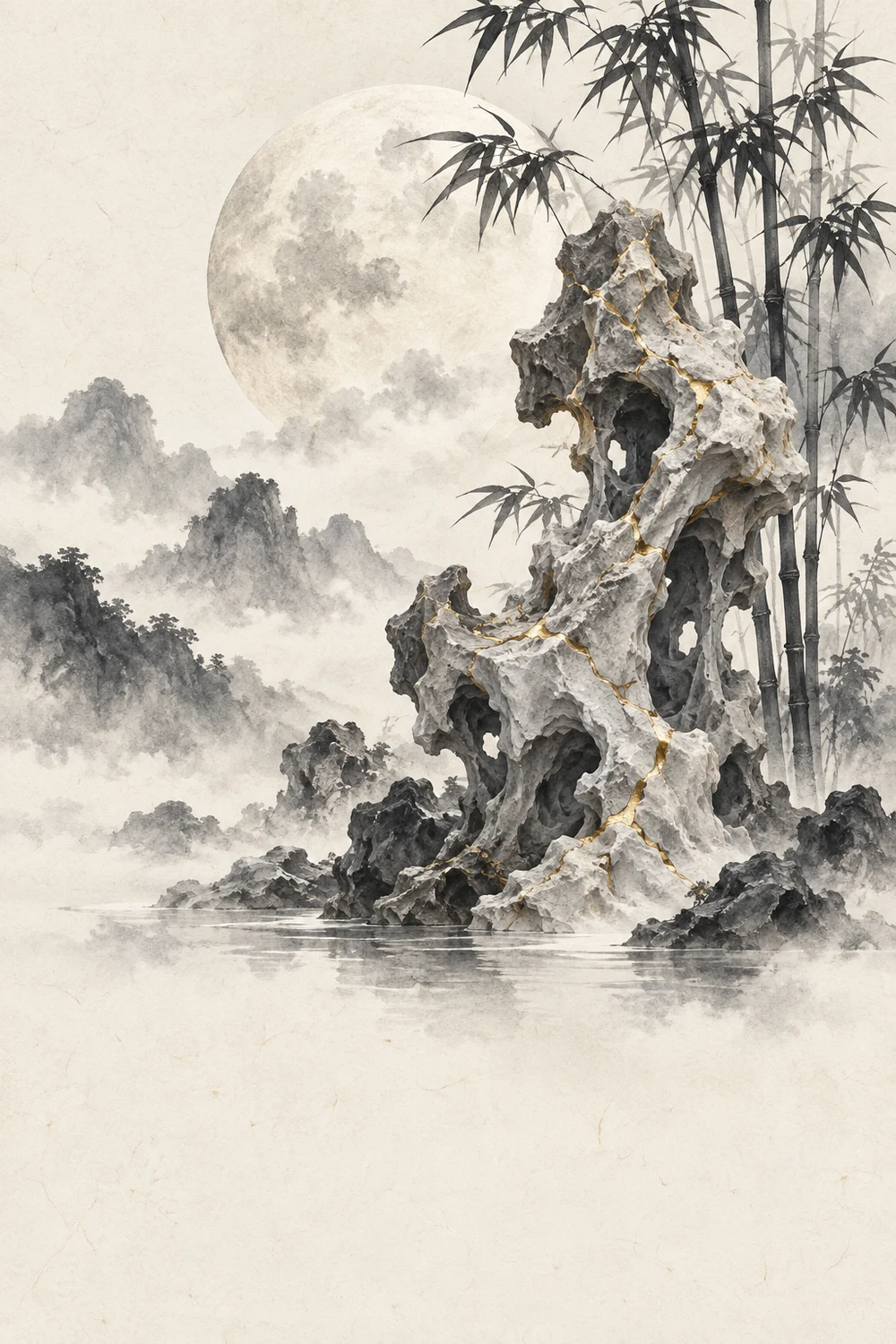
One branch across four columns
If you know you were born in a Rooster year, you already know one piece of a larger grid. In BaZi—which means eight characters—that familiar animal corresponds to 酉, romanized as Yǒu, the tenth of the twelve Earthly Branches. A branch never stands alone in a chart. It sits in the bottom half of a pillar, paired with one of the ten Heavenly Stems above it, and together the pair records a slice of calendrical time.
Because a complete birth chart has four pillars—year, month, day, and hour—酉 Yǒu can appear in any of those four columns. Spotting the Rooster in your month or hour column does not give you a second zodiac sign; it simply marks where the cycle stood at that scale of time. Even in the year column, the calendar needs a quick check. Our calculator switches years at Li Chun, the solar term in early February, rather than on Lunar New Year, so a late-January birthday still belongs to the previous branch.
Five to seven in the evening, and the Metal count
When the twelve branches divide the twenty-four-hour day into two-hour watches, 酉 Yǒu holds the stretch from 17:00 to 19:00. In our basic chart, day and hour boundaries follow recorded local civil time, with the day rolling over at midnight and no adjustment for true solar time. If you were born at 18:15 according to the hospital clock in your local time zone, your hour branch lands squarely in Yǒu.
In our five-phase bars, 酉 Yǒu contributes to Metal. The app counts the eight visible characters equally, giving each stem or branch 12.5% of the total. Classical BaZi lineages often look beneath the surface of a branch to discuss hidden stems, seasonal weighting, or overall chart strength, but our visible-character count leaves those layers out and never treats a phase percentage as a score of personal deficiency or strength.
Discernment at the end of the workday
As an editorial image, the Yǒu window—five to seven in the evening—carries a mood of completion and discernment, the hour when tools are wiped down and the day's work is sorted. You can borrow that metaphor for a concrete five-minute habit without believing a calendar character dictates your fate. Suppose a fictional graphic designer named Maya looks at a messy desk at 17:30. Instead of starting a brand-new layout, she crosses two finished tasks off her notepad, deletes three failed drafts, and circles the single decision waiting for tomorrow morning.
Does late afternoon actually feel like a sharp, clear-headed sorting hour to you, or is 17:00 to 19:00 just when you are tired on the train and deciding what to cook? A metaphor is only useful when you let real life argue back. If you generate a free chart here to see whether 酉 Yǒu appears in your pillars, treat its imagery as a prompt for noticing how you wrap up a day, while relying on people's actual choices and circumstances rather than a branch label to understand who they are.
Find the story in your own chart.
Calculate your four pillars, meet your Day Master and take away a signature card.
Reveal my signatureCalendar reference: Hong Kong Observatory: the 24 solar terms. Calculation engine: lunar calendar documentation. Archetype labels, exercises and artwork are modern editorial interpretations. Read our method.