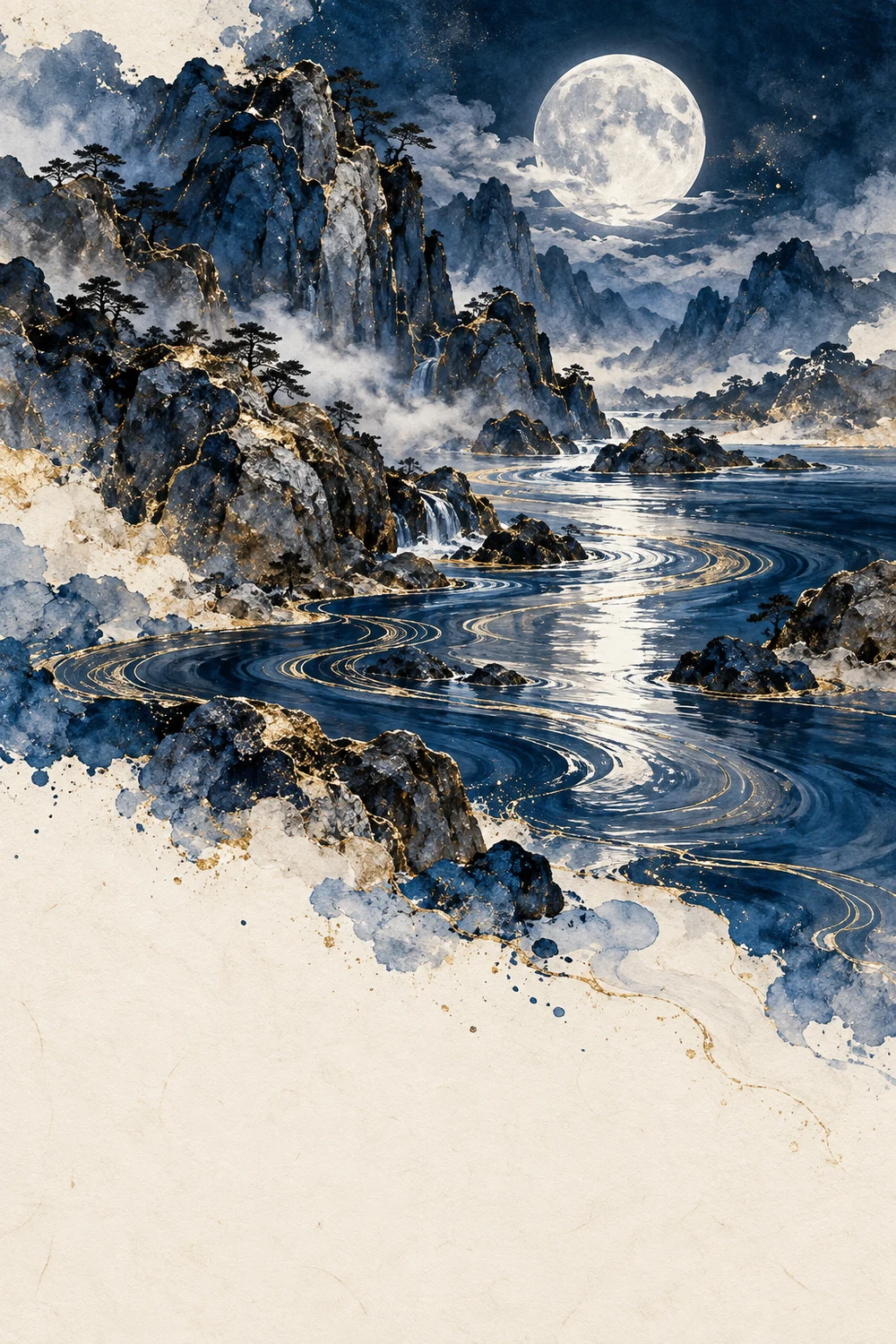
Dew, mist, and the tenth Heavenly Stem
A storm announces itself with thunder, while morning dew simply appears on the grass. In Chinese BaZi (eight characters), the Water phase splits into two distinct images: 壬 Rén Yang Water, often pictured as a fast river or open sea, and 癸 Guǐ Yin Water, associated with rain, mist, and condensation. Instead of dramatic force, Guǐ suggests gradual influence and quiet absorption.
The character 癸 is the last of the ten Heavenly Stems. When it sits at the top of your day pillar, it serves as your Day Master—the primary stem used to frame a chart. You might also spot 癸 in your year, month, or hour pillar, though appearing there does not make it your Day Master. In this project, we call the Guǐ Day Master The Dream Weaver, a contemporary editorial title meant to give you an approachable starting image rather than replace the traditional term.
When reading the room becomes inventing the plot
The metaphor of mist invites questions about nuance, listening, and imagination. You can test those themes against your own habits without treating them as a fixed identity. Do you actually prefer observing from the edges, or are you much more direct when a deadline is tight and the stakes are clear?
Even when the observant side of the image fits, subtlety has an obvious counterweight: reading between the lines can easily slip into inventing the lines. Suppose a colleague replies to your two-paragraph proposal with a single word: "Fine." An overactive Guǐ lens might spend the afternoon reconstructing their hidden disappointment. A quick, plain question—"Does this approach work for your schedule, or should we adjust it?"—often replaces three hours of silent guessing.
Separate the observation from the story
If you want to try a contemporary exercise inspired by The Dream Weaver, fold a blank index card in half during a meeting or creative project this week. On the left side, write down one concrete, observable fact: "Maya looked at her phone twice while we reviewed the budget." On the right side, write the story you are tempted to tell about it: "She thinks the project is a waste of time."
Next, look for one small piece of evidence that supports your story and one that challenges it—perhaps she was waiting for a delivery courier. Pairing an impression with a small, real-world check keeps your imagination useful rather than exhausting.
How Guǐ fits into the whole eight-character chart
Having a Yin Water Day Master does not mean your chart is dominated by Water. Our five-phase bars simply count the eight visible characters in your four pillars, giving each character 12.5% of the total. A 癸 Guǐ Day Master can easily sit inside a chart full of Fire, Earth, Metal, or Wood, and those simple bars do not calculate hidden stems, seasonal weighting, or favorable-element remedies.
If you generate your free Day Master card or basic birth chart, remember that our calculator uses local civil time with a midnight day rollover, Li Chun for the year boundary, and solar terms for the months, without true solar time correction. If you were born near midnight, another calculator using a different convention might assign a different Day Master altogether. When you feel ready to see how 癸 Guǐ interacts with the rest of your pillars, you can read the companion field notes or join our open research trial to explore a full reading and share your honest critique.
Find the story in your own chart.
Calculate your four pillars, meet your Day Master and take away a signature card.
Reveal my signatureCalendar reference: Hong Kong Observatory: the 24 solar terms. Calculation engine: lunar calendar documentation. Archetype labels, exercises and artwork are modern editorial interpretations. Read our method.